 Maintaining Momentum Maintaining Momentum
The start of 2011 will be remembered for the tragic events in Christchurch and in Japan. The CIOs and Ministry of Health people who found themselves caught up in the February earthquake survived a 24 hours that they will remember for some time.
For the IT Health Board (ITHB), 2011 will be about building on the momentum gained last year from the release of the National Health IT Plan and from initiating key projects from phase one, including Health Identity, Shared Care Planning for Long Term Conditions and Community ePrescribing.
To do this the Board has decided to focus the sector efforts on the following priority areas:
- eMedications programme
- National Systems
- Regional (DHB) Information Platforms
- Integrated Care Initiatives.
You can read more about the priorities and the 19 initiatives they
cover here.
The Board will also focus on key success factors for the health IT projects including: governance and leadership, committed funding streams, clinical engagement, IT capability and change readiness.
Recently Tony Foulkes, Chair of the DHB CEO Information Group and I wrote to all DHB CEOs to confirm our expectations for health IT investment planning over the next three years. The two key messages in the letter were:
- Expenditure on health IT should increase from two to four percent from the 2011/12 year
- DHBs need to significantly reduce the number of local health IT projects to focus on regional clinical projects.
Our challenge has been made more difficult with the economic impacts of the earthquake signalling little or no additional funding for our sector. We need to focus more than ever on the quality of investments in health IT solutions. In particular, there needs to be more effort on identifying the 'clinical value proposition' enabled by health IT investments. Some of the areas to look at include: public health and preventative initiatives, wellness and illness care plans, 'patient flow' and patient experiences, clinical engagement and the measurement of productivity and health benefits.
With this in mind the Board have recently received an evaluation report from the National Institute of Health Innovation (www.hive.org.nz) on the value proposition of eReferrals, based on the experience of the first implementation at Hutt Valley District Health Board. The value propositions are well made in the report which also identifies learnings for other regions planning to implement eReferrals solutions.
| |
|
|
| |

'Good trustworthy health information is the circulation that supports the heart of clinical practice. Lacking this robust circulation weakens the core resulting in inefficient health outputs and an inability to optimally deliver health outcomes'.
In October last year, Dr Sadhana Maraj was appointed to the position of Manager Health Sector IT Engagement. The engagement team leads consultation and engagement with various stakeholder groups to support implementation of the National Health IT Plan (NHITP) and progress initiatives targeted at improving health outcomes.
Sadhana is a medical doctor and trained at the Royal College of Surgeons in Ireland. She has worked in Ireland and England in the general surgical specialties and in New Zealand in obstetrics and gynaecology.
She recently completed an MBA at Victoria University and subsequently held roles at ACC and the Ministry of Health. She has also worked briefly with Hutt Valley DHB on the New Zealand Medicines Formulary.
Her clinical background means that she is familiar with clinician IT needs and the accompanying frustrations of clinicians who are unable to access information in a timely manner to support diagnosis and treatment across the continuum of healthcare delivery.
"Access to real time trustworthy information is an imperative for clinicians who deliver services in the community, the primary care practice or the hospital environment. Good information is paramount to supporting improved health outcomes and optimally utilising scarce resources to better manage healthcare delivery." says Sadhana.
Another important perspective that Sadhana brings is the recognition and the need to use trustworthy information to foster a culture that supports consumer involvement in key aspects of healthcare management.
She is also keen to emphasise the importance of clinical governance and clinical leadership in effectively implementing the Health IT Plan (NHITP). "We need clinicians to help govern, design, and champion IT solutions and systems that support evidence based best practice, promote integrated healthcare and facilitate access to decision support aids." To help achieve this Sadhana works closely with the National Information Clinical Leadership Group (NICLG).
Sadhana considers that a key challenge for her in this role is to leverage and strengthen the clinician-consumer relationship by promoting positive dialogue and breaking barriers in order to achieve the integrated care model.
Sadhana encourages any clinicians who would like to discuss their views with her to get in contact with her at sadhana_maraj@moh.govt.nz .
|
|
| |
|
|
After discussions with stakeholders, the IT Health Board, along with the Health Quality and Safety Commission and the National Health Board has endorsed the establishment of a sector governance group to have strategic oversight of the eMedications programme. Ongoing discussion with the Health Quality & Safety Commission is likely to result in the eMedications programme and the safe medications programme being managed closely together.
An interim eMedications Programme steering group, which had its inaugural meeting on March 18th, will maintain leadership and operational governance of the current paper based and electronic medication projects including:
- three e-pilots set up under Safe Medications Management
- ULM and formulary pilots
- community and inpatient ePrescribing
- medicines reconciliation
- medication aspects of other projects such as CDR, eReferrals, eDischarges and shared care planning.
The programme will contribute to the safe, effective and appropriate use of medicines. The overall goal is to ensure that a person's medication is accurate, up to date and accessible across the continuum of a person's healthcare by prescribers, pharmacists, other health providers and the patient themselves.
| |
| |
|
|
| |
Following the Christchurch earthquake some health practitioners were faced with an inability to access important electronic health information for their patient. This was caused when the local information record was not available because equipment was damaged or the site inaccessible.
This highlighted a weakness in NZ's current health information environment where the bulk of health information is typically held locally within GP patient management systems. This experience created the initiative to bring emergency care data from DHBs and primary care sources together under one clinical portal.
With leadership provided though joint governance between the DHB and Pegasus Health this project will develop a central repository for this information. The solution will be provided using Orion's Concerto portal software.
Getting help to vulnerable people in the community immediately following the Christchurch earthquake was made easier because of the interRAI aged care assessment programme.
interRAI is an evidence-based clinical assessment and planning tool developed in collaboration with researchers from over 30 countries.
Dr Nigel Millar – Canterbury DHB Chief Medical Officer says, "The InterRAI programme has been an enormously valuable resource in helping the emergency response teams to provide care to older people who are at high risk."
"The recent decision to roll out the interRAI assessment programme to rest home residents will add to our capacity to respond to emergencies in the future and to protect the well being of vulnerable people in care." says Dr Millar.
interRAI is being implemented at every District Health Board as part of a 3-4 year national project.
Canterbury has implemented the 'home care' tool, which is primarily focussed on the care of elderly people living at home and has been piloting a 'residential care' tool.
| |
HISO
HISO are currently working on developing the requirements for a 'core and common' dataset of terms used across the health and disability sector. It is apparent that there is a lot of disparity in the use and interpretation of same and/or similar terms throughout the sector.
Having these core and common terms defined will be fundamental in enabling interoperability across the various systems in use across the sector.
The public comment phase for the draft National Cancer Core Data Specifications closed on 23 March 2011. There were almost 200 comments received on the specifications, all of which will be reviewed by the working group that developed the drafts and will be published in due course.
The above draft specifications are currently open for public comment. They can be found here.
Any queries, please contact standards@moh.govt.nz |
| |
|
The three Auckland DHBs, Northland DHB and Health Benefits Limited have created Health Alliance.
Health Alliance is a shared services organisation that will provide services to the DHBs including: Finance, HR/Payroll, Procurement and Information Services. The formation of this organisation supports the goal of the NHITB to have a single decision maker for health IT for DHBs in each region.
The Director of the National Health IT Board recently assisted the Chief Executive of Health Alliance, Barry Vryenhoek, in the appointment of Johan Vendrig as the new General Manager, Information Services.
Barry Vryhenhoek has significant experience in leading IT investments and together with the new GM will strengthen the health IT leadership for the region and assist the NHITB on its objectives.
|
|
| |
|
|
|
| |
| |
|
|
|
|
The Minister recently attended the launch of the proof of concept for the National Shared Care Plan Pilot in Auckland. The proof of concept is being launched by Grey Lynn Family Medical Practice in partnership with the ITHB and the Northern Region (Auckland, Counties, Waitemata and Northland) DHBs.
The National Shared Care Plan proof of concept is the very first step towards a shared care plan system. It demonstrates an integrated multidisciplinary care team working off a common record and plan with the patient as a central member of the team.
|
|
| |
| |
|
The proof of concept is expected to continue for another 2 – 4 months while three other trial projects are established in other DHB areas. These trials will provide further learning and refinement to enable future rollouts to meet the sector's needs.
The proof of concept and trials will also create a better understanding of shared care planning with clinicians so they can build on the momentum of the trials to create a shared care record for patients with long term conditions in their area.
Shared care plans will be owned by the patient and shared with their wider healthcare team (across both primary and secondary care) to strengthen decision making along the patient journey. |
|
|
 |
|
| |
|
|
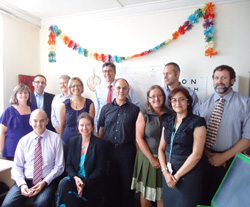
Hon Tony Ryall attends the launch of the Shared Care Plan proof of concept in Auckland |
|
| |
|
| |
| |
Consumers represented
Involving high quality input from consumers from the beginning is fundamental to the IT Health Board's governance structure for shared healthcare records. This reflects a strong belief that consumer requirements must be part of the design, and not left to be added late in the process.
The Board recently established a panel of about 20 consumer representatives. The members comprise a cross section of health consumers in terms of age group, health status, gender, ethnicity and region. Members have been recruited from a range of bodies including some of the DHBs' community panels, attendees at last year's Community Workshops, and specialist organisations.
The panel had its first full day briefing and training session in Wellington on March 29th. It is intended that some members will be co-opted to project governance groups, working parties and boards that are dealing with diverse elements of the shared healthcare project. Their involvement will be to ensure that the consumer perspective stays at the forefront alongside those of clinicians and IT specialists.
The panel will meet periodically to compare experiences, debate key issues and provide feedback to the IT Health Board. |
| |
|
| |
|
|
The National Institute for Health Innovation (NIHI) has completed an evaluation of electronic referrals (eReferrals) at Hutt Valley DHB, and provided their initial report to the ITHB. The Board has commissioned NIHI to evaluate four e-Referrals implementations. Northland DHB, Canterbury DHB and the Auckland metro region eReferrals will be evaluated progressively over 2011. The evaluation studies are intended to capture the learning's for future implementations, and to provide suggestions for refinements.
The findings reveal GP-to-hospital eReferrals are promising for wide-scale uptake throughout New Zealand. Particularly if eReferral implementations are seen as enablers of innovation rather than cementing in the present paper based health delivery processes. Implementations need to plan for ongoing refinement to further enhance performance and end-user satisfaction. Click on this link to see the report.
The ITHB acknowledges many DHB's have patiently waited for the eReferrals evaluation and the outputs of the Auckland Project. The Board is now in a position to support other DHB's commencing work on Stage One of eReferrals with the following guidelines;
1: Implement GP to the hospital e-Referrals using the vendor agreed by your region, following
established procurement processes.
2: Re-use the referral templates developed in the Auckland project, preferably keeping the number of
templates to a minimum.
3: Use Orion Concerto for the triage tool (hospital triage) when the development is completed in Auckland.
Evaluation Tool; A secondary purpose of the evaluations is to inform the development of a general framework for evaluation of health IT projects, particularly projects with a strong focus on transformation of healthcare delivery.
|
|
|
| |
| |
Regional Information Technology Plan Reporting.
The National Health Board Information Strategy Group are currently updating the Systems Landscape Regional Focus Report and the Regional Readiness Assessment Report in conjunction with the Chairs of the Regional CIO Forums.
Once the updates are validated with the CIO's they will be presented to the National Health IT Board Meeting on 13 April 2011. The reports will also be tabled for discussion with the DHB CEO Information Group.
Updates will be generated across the following reports:
- Systems Landscape Regional Focus- showing baseline, actual changes and annual forecasts towards the 2014 Target State.
- Regional Readiness Assessment – measuring progress.
- Combined Regional Timeline – showing overall plan in GANTT chart format.
|
| |
|
|
|