 Welcome to the first issue of Towards 2014, the IT Health Board's newsletter. As we approach the end of the year, it seems like a good opportunity to reflect on how far we've come since the Board's inception just over a year ago. Welcome to the first issue of Towards 2014, the IT Health Board's newsletter. As we approach the end of the year, it seems like a good opportunity to reflect on how far we've come since the Board's inception just over a year ago.
Our most significant development is the release of the National Health IT Plan. For the first time we have a road map that is enabling the sector to work collaboratively towards a common goal – the achievement of a shared care model.
You can find the 2010 version of the plan here on our website. This version (published on 3 November) incorporates valuable contributions from sector participants, including the NHB and Ministry colleagues, the National Information Clinical Leadership Group and consumers (engaged through a series of regional community workshops, see article below).
Having recently attended the HINZ Conference and the Partnership Summit, it appears the current mood towards the IT plan is both positive and energised, with everyone accepting the need to collaborate and deliver on a smaller number of key regional and national projects. We are starting to see many initiatives from the plan in progress. Check our website for regular progress updates – see Our Progress.
The IT Health Board has demonstrated success in several ways over the past year, most notably in the following significant areas:
| • |
Promoting governance and leadership across several areas, including Patients First Group, DHB CEO Information Group, National Information Clinical Leadership Group, National Programmes, Consumer Forum, and Vendors/Health IT Cluster
|
| • |
Providing greater visibility to the sector for IT initiatives that will lead to the shared care paradigm
|
| • |
Endorsing business cases against the IT Plan and supporting proposals for funding from Primary Care Grants funding.
|
| • |
Working with other key stakeholder groups to progress initiatives from the Plan
|
| • |
Involvement in and progression of nationally led programmes of work e.g. e-Medications, Shared Care plans. |
As with any organisation, we face a number of challenges if we are to reach our goals. To overcome these challenges, we must continue to work together as we progress towards the path of shared care and ultimately better health outcomes for all New Zealanders. We look forward to working with you in the new year.

| |
|
|
| |

Two national programmes - Shared Care Record for Maternity and Shared Care Record for Long Term Conditions - are being run by sector governance groups in partnership with the IT Health Board.
Both projects are working to define and develop a system or series of systems to support the concept of shared care as set out in the National Health IT Plan. The goal is to deliver a working shared care system (selected population) after two years, and to make it generally available to all patients and health practitioners over a period of four years.
Shared Care Record for Long Term Conditions
The IT Health Board is working with a steering group of clinical and management representatives in the Northern Region to progress shared care records for long term conditions. Health Alliance, as the lead agency, has established the National Shared Care Plan to initiate projects that will trial approaches to shared care in the area of long term conditions.
Shared Care Record for Maternity.
The Shared Care Record for Maternity has been set up as a national programme. The governance group has representatives from the College of Midwives, RNZCGP, College of Obstetricians and Gynaecology, Plunket, Paediatrics, Ministry Child Youth and Maternity, and IT Health Board staff.
The project aims to have selected districts on board with a working system within two years, moving to full coverage of all births and the development of shared care record for children, as soon as possible thereafter. The initial development will enable health practitioners (nominated by the expectant mother) to access and/or efficiently transfer information electronically. Initial funding for the programme has been approved by the IT Health Board. Expressions of Interest and independent evaluation will be conducted in the early new year.
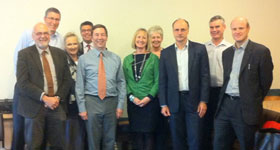 Members of the Shared Care Record for
Maternity Governance Group
|
|
| |
|
|
In July and August the IT Health Board partnered with the Telecommunications Users Association of NZ (TUANZ) to run a series of community workshops across the country. The aim of the workshops was to examine the issues associated with shared healthcare records from the perspective of consumers.
What we found was an overwhelmingly positive acceptance of the concept of shared health records. The consumers we spoke to around 250 people, with links to a wide range of consumer-centric organisations – were most interested in discussing aspects of special sensitivity including information, access permission, audit, opinion versus results, and privacy. A report on the workshops and their outcomes can be found here.
| |
| |
|
|
| |
Auckland and Waikato DHBs have tackled the shortage of experienced clinical coders by creating New Zealand’s first on-line training course for clinical coders. The ACE (Accelerated Coding Education) course is customised for the New Zealand coding environment, delivering an accelerated training pathway through on-line training and support tools.
An early goal of the National Health IT Plan is to ensure the benefits from the smart use of IT are spread across the health sector. The ACE course represents a sustainable way of using IT to support and develop clinical coders, through a scalable, electronically delivered and potentially national solution. Click here to read more.
The National Health Board is establishing a new governance group that will be responsible for all e-medication projects under the eMedications Implementation. The Health Quality and Safety Commission (HQSC) will govern all medication safety and quality issues from a policy and best practice view point. Both the National Health Board and the HQSC will work together to implement the new governance structure early next year.
The Ministry Major Projects Committee is one of four core bodies delivering the National Health IT Plan (see all delivery groups here). The Committee manages a prioritsed list of Ministry of Health-led IT projects.
Cabinet has now approved the next phase of investment for the Health Identity Programme. The programme will see the replacement of original systems that are now 17 years old, implementing a national health identity solution by June 2012. The Programme is endorsed by the NHB and Capital Investment Committee, and has cross-Government support.
The programme will deliver the necessary building blocks to address limitations in the current national health identity systems used in the health and disability sector. A summary of the business case, including a timeline of delivery, is on our website.
Connected Health is establishing an environment for the safe sharing of health information. It is a standards-based, commercial model for the delivery of universal connectivity across the health sector. This means health organisations will be able to choose products from different suppliers and be confident they meet the standards.
In November the IT Health Board announced the Connected Health Certification of six networking products. Click here to see the list.
Every year as a requirement under the Operational Policy Framework the Ministry initiates the National Collections Annual Maintenance Project (NCAMP) to maintain the currency of code sets, improve quality of information, and enhance reporting capability.
| • |
an update of the Australian Refined - Diagnostic Related Grouper (AR-DRG) from version 5 to 6 and corresponding costweight calculation changes (WIES) |
| • |
formatting changes required for facility codes, and purchase unit codes in the NMDS (National Minimum Data Set) and NNPAC (National Non-Admitted Patient Collection) |
| • |
integrity and data quality fixes for NMDS, NNPAC and NBRS (National Booking Reporting System) |
Draft sector notifications have been sent to the NCAMP user group. Final notifications (which will finalise the specifications but will not change the overall scope) are being developed and will be sent out this week. For more information email ncamp@moh.govt.nz. |
|
| |
|
|
|
| |
| |
Until now most DHBs have used different clinical workstation software in their hospitals (different versions, different vendor software, different information standards) which has been challenging. Clinicians are a mobile workforce: locums are often used in hospitals and clinicians in training rotate every six months to a different hospital, so they also have to take time to get up to speed with a new system.
Phase 1 of the National Health IT Plan set the expectation that each DHB region should move to a common/standard software product for their hospital clinical workstations.
After analysing the options, the Board decided the benefits of having a single clinical workstation system in all hospitals - increasing patient safety, reducing the complexity of the health IT environment and the effort required to implement new system changes - far outweighed the loss of competition.
As a result both the Midland DHB Region and Southern DHB Region have recently agreed to move to the same software. This means that in future Orion’s Concerto software will be the common clinical work station solution in all New Zealand hospitals.
Read more great examples of the plan in action here. |
| |
|
| |
| |
National Clinical Leadership
One of the key challenges facing the New Zealand health sector is how to advance the development and use of clinical information systems on a national basis consistently.
With the creation of the IT Health Board, the role of the National Information Clinical Leadership Group (previously known as the Clinical Leadership Group, established in 2009) has extended to providing clinical leadership input to the National Health IT Plan. This recognises the fact that clinical leadership is required at a national level for 'transfer of care', which translates into three current areas: e-referrals; e-discharges; and GP2GP transfer. The group is chaired by Peter Gow, (see his comments on the HINZ Conference below).
The group has provided valuable clinical input into a number of significant projects. Read their list of accomplishments for 2009/10 here.
|
| |
|
| |
|
|
 The 9th Annual HINZ Conference and Exhibition took place in Wellington last month. It is always well-attended by health IT professionals and vendors, but HINZ’s goal for the future is to increase clinical attendance. Peter Gow (pictured right), Chair of the National Information Clinical Leadership Group, took time out from his busy job as a rheumatologist at Counties Manukau District Health Board, to attend the conference. Among the many excellent presentations, four sessions stood out for Peter: The 9th Annual HINZ Conference and Exhibition took place in Wellington last month. It is always well-attended by health IT professionals and vendors, but HINZ’s goal for the future is to increase clinical attendance. Peter Gow (pictured right), Chair of the National Information Clinical Leadership Group, took time out from his busy job as a rheumatologist at Counties Manukau District Health Board, to attend the conference. Among the many excellent presentations, four sessions stood out for Peter:
The Power of Personal Health Records to Ensure Clinical Transformation by Patti Brennan. This showed the importance of consumer engagement in the process, and the need to be aware of the social context, particularly for young people
Why do evaluations of e-Health Programmes Fail an alternative Set of Guiding principles by Professor of General Practice Tricia Greenhalgh Although the academic study of the evaluations of the Shared Care Record Programme from the NHS was of academic interest, it was also a chilling indictment of a poorly designed programme that did not take account of the importance of the users of the system and the change management principles required, in contrast to the top down ideological vision and autocratic methods which were used.
Outcomes and Impacts of Telehealth in Alaska: an 8 year Retrospective by Stewart Ferguson and John Kokesh Delivering clinical care in a country with vast distances, poor roading infrastructure, and expensive air travel is challenging. This presentation showed that an engaged clinical workforce can work together to develop innovative solutions assisted by information technology to the benefit of the patients and with better job satisfaction for the clinicians, assisted by “measurement for improvement”. This was the “show us the right way” highlight.
From Clinical Information Systems Toward HealthGrids Yannick Legre This showed that shared resources with innovative technology can expand the influence of electronic information in a cost effective manner, in a boundary-less virtual world, using principles which combine the social marketing ethos with business acumen. It was a vision for the future.
Read the full interview on our website |
|
|
| |
|
|